Product Tree
|
InGaAs High Speed Photodetectors with AC Coupling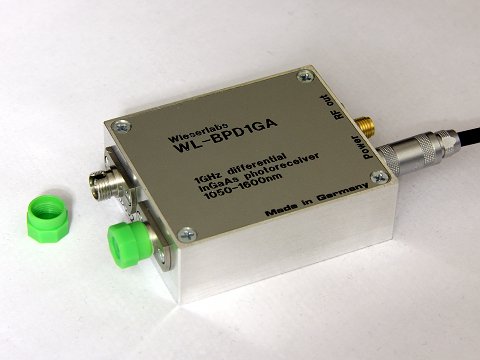
WieserLabs offers high speed InGaAs photodetectors, in both single-ended and dual-balanced versions. All these photodetectors feature
Remember: AC coupling in the detectors suppresses the DC light intensity preventing amplifier saturation even at high input levels. Such detectors are useful whenever the AC signal is relevant and the DC offset can be suppressed, like for pulse measurements, swept source optical coherence tomography (SS-OCT), certain noise measurements. However, for CW intensity monitoring, DC-coupled rather than AC-coupled photodiodes must be used. Single-Ended PhotodetectorsSingle-ended photodetectors have one single light input. They are useful whenever fast light modulations have to be detected, e.g. for pulse monitoring, propagation time measurements, offset locks, etc. Due to their high trans-impedance gain and low noise, these diodes are also well-suited for intensity noise measurements.
* Coming soon. Dual-Balanced (Differential) PhotodetectorsDual-Balanced (i.e. differential) detectors feature two complementary light inputs. They are especially suited for applications where complementary signals are available, e.g. at the output of an interferometer. The dual-balanced detector amplifies the difference of the incoming light intensities thereby suppressing common-mode noise. Furthermore, for complementary signals, gain is increased by 6 dB (factor 2 in output voltage) compared to single-ended detection. Of course, all WieserLabs dual-balanced detectors can also be used as single-ended ones simply by using only one of the two inputs.
|