|
Product Tree
-
Photodetectors
-
Laser Diode Drivers
-
Radio Frequency (RF)
|
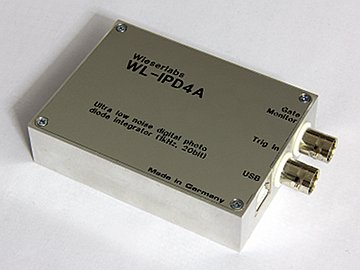
WL-IPD4A:
Digital Integrating Photodiode with USB
Description
The WL-IPD4A is a highly-integrated true gated
charge integrator to be attached directly to up to
4 photo diodes. After a trigger pulse, all 4 inputs
are integrated simultaneously for an adjustable
amount of time (boxcar integrator). The measurement
is digitized with integrated 20 bit analog-to-digital converters
and transferred over the USB link to a computer.
The customer has the full choice over wavelength and sensitive area
by providing the photodiodes to be integrated into the WL-IPD4A.
Both silicon-based and InGaAs-based diodes with different sensitive
areas can be used.
The WL-IPD4A comes in a rugged aluminum case and is powered
via the USB connector.
NOTE: For new applications, consider using the
IPD4B. This is the successor of the IPD4A
with an improved feature set.
Typical Applications:
-
Laser pulse monitoring and signal
measurement in 1 kHz systems
-
Shot-to-shot pulse noise measurements
-
Digtial 2 or 4 segment photodiodes
Features:
-
simultaneous integration of up to 4 inputs at up to 1.15 kHz
-
each measurement includes signal and background acquisition
-
gate time 8us to 64us with internal timer
-
high accuracy, low drift
-
tunable full range 12pC to 350pC
-
easy-to-use USB interface
-
very high resolution due to 20 bit ADC
-
extremely low noise integrator:
for 350pC full scale range <10ppm noise and
<20ppm noise down to 50pC full-scale range (typ.)
-
external trigger rising or falling edge
-
small form factor: 60 x 83 x 21 mm (60 x 83 x 20 mm also available)
-
Comes with easy to use LabView drivers
Typical configurations:
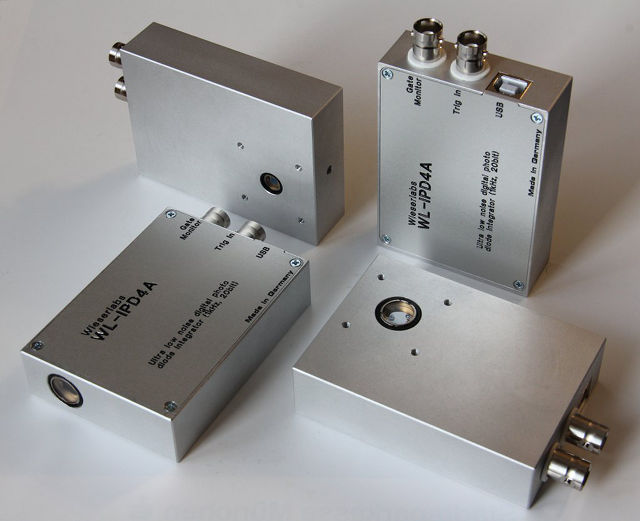
Photo shows different typical configurations of the single channel
version of IPD4A.
|
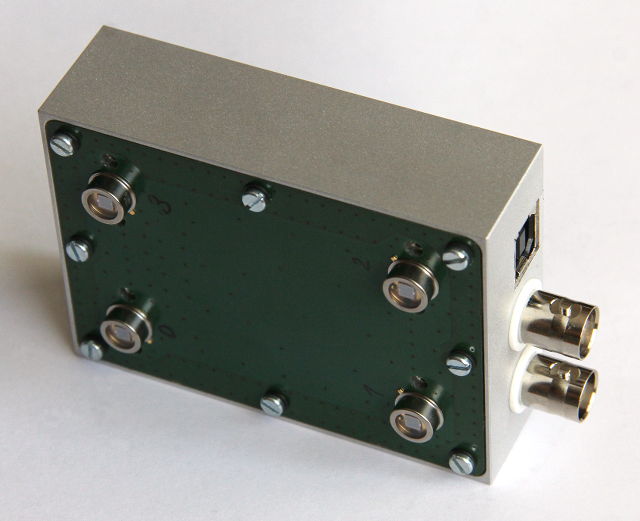
Alternate configuation with pluggable PCB on the bottom to mount photo
diodes.
|
Application Notes:
Femtosecond fluorescence spectroscopy based on the optical Kerr effect
R. Mundt, G. Ryseck, P. Gilch, Femtosecond spectroscopy group, Chemistry,
University of Düsseldorf, Germany (May 2014)
|